On this day of brown,
Stuffed turkeys, friends are thankful
They're upwind of me.
Thursday, November 26, 2009


Wednesday, November 4, 2009
Compromises and evaluating outcomes
This isn't response to any specific thing. Just thinking aloud.
I think one of the things that drives a lot of us crazy is the gulf between what is and what we think ought to be. It's driven me stark raving mad on several occasions. But, I think in our more pragmatic, less ideological moments, we can appreciate that progress is measured not just against ideals, but against alternative outcomes. I still struggle mightily with this, but the more I consider it, the more I feel it's healthy and, long-term, more productive.
We may not always be able to face the clear choice between pure and corrupted processes or outcomes. Instead, we might have to content ourselves with probabilistic arguments about choices and outcomes that are superior to alternatives.
This is NOT an endorsement of nihilism/fatalism. A case-based strategic evaluation of a lot of problems is still vital for overcoming external and internal problems. But it might be a willingness to explore, and at some point, more fully articulate the need to stop smashing against the glass wall standing between the present and unrealistic dreams.
Wednesday, October 28, 2009
Dale Corson

It appears a new book and DVD has come out on the life of Cornell President Dale Corson. I look forward to reading this.
http://www.news.cornell.edu/stories/Sept09/CorsonLegacy.html
I had the opportunity to interview Dale a couple times at the Kendall retirement community in preparation for a 50th anniversary Sputnik panel discussion. He is, today, at 95 years young, a bright and wonderful conversationalist. I began to understand WHY there are jokes about Kendal having a better physics department than Cornell - there are a lot of brilliant people there.
I think the book focuses on his tenure as Cornell President and controversies centered around the Vietnam protests. But I'm actually more interested in his earlier years. From what I gathered, Corson was a figure in the Presidential Science Advisory Council and was party to the remarkable post-Sputnik efforts in science education. He was also a key figure in creating Cornell's Science and Technology Studies department.
If you're interested in science policy or the history of science in postwar America get a chance, try to get a chance to speak with him. His legacy continues to be written - as are all of ours - by simple words and stories that, unknown to the speaker, sticks with the listener for a long time.
Old Words
I recently sent out some tutoring applications, which gave me an opportunity to peruse some dusty files from my academic career. I stumbled across an essay I had written for the National Science Foundation Graduate Research Fellowship Program.
I'm a little surprised how much my perception of the essay, and myself, has changed since late 2005. As late as 2007, I had thought it was a pretty good essay, and that by writing it, I was holding myself to the standards I had outlined. I had spent a couple months working on it, passing drafts back and forth with my adviser. To this day, I'm grateful for his tremendous insights into the grant application process, as well as the time and effort he expended on my behalf.
I'm a little surprised how much my perception of the essay, and myself, has changed since late 2005. As late as 2007, I had thought it was a pretty good essay, and that by writing it, I was holding myself to the standards I had outlined. I had spent a couple months working on it, passing drafts back and forth with my adviser. To this day, I'm grateful for his tremendous insights into the grant application process, as well as the time and effort he expended on my behalf.
Monday, October 12, 2009
Willy Brandt and Barack Obama
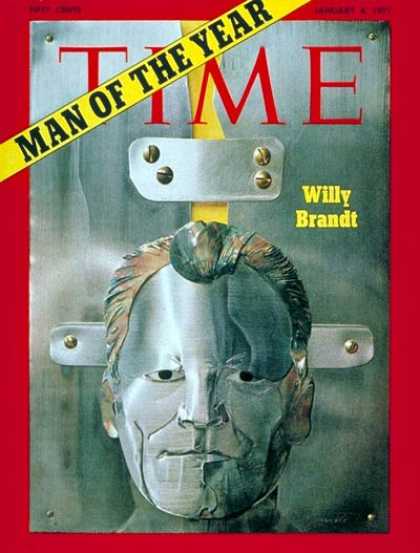
I spent a bit of time this morning reading about former West German Chancellor Willy Brandt, prompted by comparisons with Obama on receiving the Peace Prize. (Brandt received it in 1971 after articulating a policy of Neue Ostpolitik - engagement with the Communist East, but before substantial tangible progress had been made.)
Frank Rich as a model 21st century columnist
I'm linking to Frank Rich's most recent Op-Ed piece on the dangers of escalating the war in Afghanistan ("Two Wrongs Make Another Fiasco"). But before going into the content, I wanted to highlight that Mr. Rich, perhaps better than any other Op-Ed contributor at a print publication, makes liberal use of embedded links. I find this an incredibly useful tool to those of us who read the NYTimes online.
Subscribe to:
Posts (Atom)