Showing posts with label politics-American. Show all posts

Thursday, November 17, 2016

The American faith

I'm American by birth.

But I'm also American by choice.

My family -- not me, but my family -- has endured a bit of shit here. My mother's side was interned. My father's side lost an uncle fighting in the 442nd. I lost a great-aunt in the Hiroshima bombing.

It's not always productive or wise to analyze historical grievances. I'm not going to claim that they went through more or less than anyone else. But I do take pride that my family stayed, and worked, and served, and had children, and lived. "Endure. In enduring, grow strong."

My family didn't produce generals, or cabinet secretaries, or tech savants. We produced mostly teachers and gardeners and clerical workers and programmers and a couple artists. And that's okay. They shed the language, shed the culture, and did what they could do to build a life. And to America's credit, they were allowed to.

I use my race, and my history, to understand certain things. But it's a tool for understanding, or a way of empathizing. The past is not a good place to live; I will take care to be a visitor, and not a resident.

I have learned, and continue to learn, about this nation's sins, both past and present. I have come to see it more clearly (though still through a glass, darkly). I have, slowly, started to listen, to add the historical memory of others to that of my own.

And I still love this country. It has given me much. And it continues to be where I place my heart. It's my faith, the one I have explored and clung to for my adult life.

I do not use that word lightly. Faith demands sacrifice. Faith is a constant struggle. Sometimes, faith seems like a lonely road. I believe faith is a covenant, not a comfort. It is not the faith of a child, but the faith of the adult, who has seen things, learned things, and still believes.

Not everyone feels loved by this country. And that cuts across lines of race, faith, class, gender, orientation, and other categories. And that's a tragedy. It's my personal tragedy, and I feel it as a personal failing. And I'm going to do better about that. I'm going to listen more. And I'm going to reach out more.

I'm going to stay here. And I'm going to work, in my own, small, humble ways, to make it a bit better. Because, now, more than perhaps any other time in my life, my friends and family and country need me. And to be needed is such a powerful thing. Do not feel badly or scold those who cannot, or will not. We all live our faith in different ways, and there is no one best way to love.

I will continue to love this country. And I hope, by setting a good example, by standing up, infrequently but firmly, by training for the marathon, not the sprint, I can be a good citizen, and help others feel loved by their country. It won't be enough. It's never enough. But it's what I'm going to do. I don't know quite how yet, but I'm figuring it out.

Because you are the part of America that has loved me, inspired me, and made me a better man. You've given life to the abstract ideals. You've given of yourselves to make your corner of the country better. You've laughed -- laughed -- and that laughter, indeed, opens.

Of all the jumble of identities I carry, "American" is the most important to me. And I'm going to place that centrally in the coming years, and do a better job of living this faith, and loving you.

Monday, November 7, 2016

Election Day


Today was the first day I asked myself a very specific question:

Was Grandma allowed to vote?

Specifically, I wondered whether Grandma was allowed to vote while interned in Rohwer.

For those of you who don’t know, my maternal grandparents and all of my mom’s older siblings were interned during World War II. (My father’s side was not -- they lived in Maui, and most of the Hawaiian Japanese-Americans were not interned. Some fought, including my grandpa’s brother, who died in a corner of France.)

Wikipedia didn’t have anything. But PRI’s The World did a characteristically excellent story on the matter.

The gist is that there was voting, but it was difficult, and the combination of ballot challenges, state laws, and logistics meant that voting rights were pretty much eliminated.

I try to avoid thinking too much about my racial or cultural identity. But otherness has been a feature of this election in a way that it hasn’t been, at least in the memory of my political life. And so it was perhaps inevitable that I’d come back to that memory, and think about what was, and what might have been, and of course, what may yet be.

It is with a renewed intensity that I gaze upon efforts to make voting harder, not easier. It is with renewed anger that I consider the efforts to change election laws, under the pretense of reducing fraud, to disenfranchise segments of the population. Because it was not so long ago that my family lost those rights, through no fault of their own.

And it’s with some amazement that I consider that, after that experience, my grandparents rebuilt, had sons and son-in-laws serve in uniform overseas, and voted. I wish I had the “I LIKE IKE” button that my grandpa had hanging near his desk for decades. I wonder if he ever knew that Milton Eisenhower led the War Relocation Authority. As a farmer/small businessman, he probably was a registered Republican.

I’m grateful he didn’t get bitter. I’m grateful he didn’t give up. And I’m grateful that he was permitted -- not easily, but permitted -- to rebuild his life. It’s a sobering lesson for me. I’ve experienced nothing remotely close to that level of dislocation, humiliation, and -- I don’t think this is an exaggeration -- state-sanctioned theft. I laugh at my friends who worry about big government taking away their rights or seizing their property. But then I feel shame -- every family has stories of civic failure and grievance, whether governmental or private. It does no good to dismiss their concerns and pain out of hand.

That’s going to be the hard part after today. How do we work together? How will the victors frame their victory in a way that at least reduces the chances that we will spend the next two or four years or decades as two armed camps, unable to do much because we begrudge each other the smallest things?

Because I do think a lot of people are terrible. I do think that support of Trump flies in the face of everything I know and love about this country. I do think that it shows a marked historical ignorance, a lack of empathy to those who would most be hurt by a Trump presidency that borders on callousness and selfishness. I do think that plenty of people, even people more or less on the same page as me, have become stark raving mad.

And I believe I have been one of those madmen.

I've embraced the toxicity that I criticize in others. I've become the partisan that sees winning as essential, even existential. And in my saner moments I feel shame at being part of the problem.

So I’m trying, hard, to remember certain things. I remember that my love for this country is not the naive love I had as a young child. It’s a love that is more aware (though still partially blind) to the real historical truths, and the present truths, experienced by those different from me. I see those flaws, and that pain, and the wars and the cruelty and the short-sightedness.

But I’m finding the strength to not just criticize or willfully ignore it. I’m finding the love that demands I reach out, and do things that are uncomfortable and hard, and pride-crushing, because I know that it makes my tiny corner of the world better.

Not enough. Never enough. But some. And maybe, after today, some more.

I love this country because of its history, too, and not just in spite of it. I marvel at how some individuals and communities discovered, in their pain, in their oppression, in their privilege, something greater, something beyond the limitations of I or tribe.

That all heroes wilt under the scrutiny of history and hindsight is necessary, and even desirable. If America depended on perfect women and men to achieve greatness, we would have no hope to maintain, much less advance, this experiment. I have looked into the mirror, and learned to appreciate the flaws, the dark shadows, without sentiment or excuse. Our scars are our story, though one hopes, not our future.

So this I pray -- and I say that sincerely as a man who has struggled to bend his knees and bow his head, but does so now, at a time of acute need. I pray for a peaceful election day.

I pray for good judgment on the part of the people.

I pray not for an easy life, but to be a stronger man.
I pray for powers equal to my tasks. (Phillip Brooks)

I pray that I remember that the spirit of liberty is the spirit that is not too certain that it is right. (Learned Hand)

I pray I learn how to borrow from those who came before, from those who know more, and love more -- that my pride does not prevent me from leaning too much on my own understanding, but that my honor demands that I develop my understanding to ensure I am not a weak reed.

Today, I will cast my ballot, thinking about my family that, within living memory, was denied that right. I will vote mindful of the past, with an eye toward the future, our future.

I cast it knowing that this is but a piece of citizenship -- that I will judge my worthiness of that vote based on what I do between elections to better advance this nation and the world, and the extent to which I have opened my heart to those across the fissures and chasms of discord and fear.

Today will be the expression of our will. But every day is the expression of our character.

To you good men and women: I pray you vote wisely, live well, and love openly. For you are why I vote, why I live, and why I love. Thank you.

Wednesday, October 19, 2016

Chant of the Decideds

Low
Low
Stoop and writhe

Love
Love
Stand and rise

Cry
Cry
Wretched year

Sing
Sing
Shed your fear

Sigh
Sigh
Shake your head

Laugh
Laugh
Hug instead

Scream
Scream
Punch and choke

Lift
Lift
Go and vote

Pray
Pray
Time long gone

Work
Work
Never done

Shame
Shame
Cannot last

We
We
One at last

Friday, April 1, 2016

I am endorsing Ted Cruz for President

I have not made this decision lightly. I have thought long and hard about who is best suited to lead America. My thoughts on the nature and demands of the presidency have been informed by the history I have lived, and the history I have read. And I have decided that Ted Cruz has what it takes to be President of the United States, and to be a good one.

At present, we have five options between the Democrats and Republicans. All of the other four are fundamentally, and fatally, flawed candidates, and would bring ruin to us all.

On the Democratic side, we have Bernie Sanders, an avowed socialist, whose loyalty to the Democratic party run only as deep as the duration of his presidential run. His plans for free college, free healthcare, free everything, represent the apotheosis of our contemporary "gimmie-gimmie" culture. In his quest to make us Sweden, he would bankrupt us and turn us into Zimbabwe. He fails to take seriously that our present is not our own -- it is inherited from our parents, and borrowed from our future. America is not for sale for thirty pieces of silver. Despite his rhetoric, he has demonstrated by his appeals toward individual selfishness and class warfare that he is the most cynical of the candidates.

We also have Hillary Clinton, who has more baggage than an international airport. Her husband took credit for an economic boom inspired by the conservative budgets and tax policies pushed through by a Republican Congress. Despite his claims to humanitarianism, as president, he ignored a genocide in Rwanda, and exacerbated ethnic conflict in Yugoslavia. I won't even get into his personal character--that is a matter of public record. Don't believe for a second that his fumbling, corrupt hands would be idle during the presidency of his wife. As to Hillary -- she presided over the Obama State Department, and it is on her doorstep we leave the wreckage of Syria and Iraq, the nightmarish metastasizing of Islamic State, the expansion of Russia, the chaos of Yemen, and, yes, the assault on our Western allies. She is uniquely characterized by horrible judgment, changing her views more times than people change their socks. Bernie would simply bankrupt America -- Hillary would continue Obama's strategy destroy American power and sacrificing our allies for promises from nations who demonstrate neither trustworthiness nor stability.

And what of the other Republican? John Kasich? A man whose sheer ambition and arrogance has kept him in this race, even though he has won only one state, even though he has no chance at a nomination? John Kasich, who may make a deal with the devil himself for a vice-presidential spot to satiate his pride? John Kasich, whose endless pretense of bonhommie tries and fails to conceal his general grouchiness, poor temperament, and provincial small-mindedness -- none of which makes him capable of handling the job of the Presidency.

Donald Trump is no Republican. He is a creature of the media. They love him because he makes them money. He loves them because he's a narcissistic buffoon. His views are a mishmash of convenience and drug-addled somnambulence. He is the most depraved man to ever seek the presidency. It is only out of desperation that so many have turned to him -- as if to say, "We exist! Hear our voices!"

Ted Cruz hears their voices. He understands their suffering in this fake economic recovery, which has benefited the celebrities like Trump, but left behind decent, hardworking people. He understands that people are tired and angry about the desecration of American promise. He shares their anger at the academic-media-entertainment complex, who tell us constantly, be ashamed, apologize, and you deserve nothing.

They push a narrative of American weakness and attack values that have kept America safe and whole for centuries. They expect us to abandon what is good and true about our unique nation and change in response to the whims of celebrities, so-called-activists, and other braying asses, who are absent and silent when America is attacked and our citizens slaughtered. Finding no strength of their own, they seek to make the rest of us weak, and I'm sorry to say they have partially succeeded.

Ted Cruz is not afraid to ask Americans to sacrifice. He knows that, while many of our countrymen seek only handouts and attention, there are many of us, a moral majority, who know that this country is worth personal sacrifice. He is not afraid of asking us to be adults, to make hard choices needed to manage our deficits. He has fought these battles, sometimes alone in the Senate, and earned the scorn of the political class he threatens.

He is highly intelligent. He has the energy of youth, and the wisdom of a close student of history. He will not flinch to defend our country from enemies foreign or domestic. He will restore the values of our faith, in our government and in our God, to the center of American life. He is the last, best hope for a world spiraling out of control.

I ask all right-thinking Americans, all Americans who love their country, who believe that our lives are a gift from the Almighty, who believe that salvation requires sacrifice, who believe that we must fight today, tomorrow, every day for a better future, to fight for Ted Cruz. He's been fighting for you. He's been fighting for us all.

America is ours. Fight for it.

Saturday, October 31, 2015

You're a Communist, Charlie Brown

What if Peanuts is a metaphor for the Cold War?

What if Charlie Brown was Soviet Russia, and Lucy was America?

Charlie Brown, always pursuing the (nuclear) football, only to be thwarted by American spycraft?

Charlie Brown, seen reaching out to minorities within America to demonstrate the contradictions and hypocrisies within American democracy?

Charlie Brown, who insinuated himself into the hearts of others via the cat's paw of an affectionate dog? Snoopy? To snoop?

Charlie Brown, whose Snoopy agents facilitated the hippie/counterculture movement, culminating in Woodstock?

Charlie Brown, eventually eclipsed by an ascendant Snoopy (China), who sought to assert his own identity and destiny by becoming the true leader of Communist power?

Charlie Brown, whose unrequited flirtations with Peppermint Patty reflect the uneasy relations Soviet leaders had with East Germany, an athletically dominant but restive and ultimately uncontrollable satellite?

Charlie Brown, ultimately rendered impotent by his many internal contradictions and divisions?

If so, then what does that make Lucy? The domineering, physically aggressive, narcissistic force of wrath and vindictiveness?

Ready to diagnose problems in others while offering no useful insights, but charging for the time?

Dragging a younger brother Linus (Great Britain) into conflict after conflict, using the blanket (nuclear umbrella) as leverage?

Completely self-unaware about her own flaws?

Flirtatious with Schroeder (Europe), and yet rejected by him over and over again because her nature was so at odds with his own?

Poor Sally and Linus. They would find love, if they were not pawns in the Great Game. At least the lesser nations always believe so.

Sunday, August 30, 2015

McKinley, according to Theodore Roosevelt (via Edmund Morris)

http://www.independent.co.uk/news/presidents/william-mckinley-1417412.html.
(Yes, I'm citing a UK paper for a pic of an American President.)


Mt. McKinley was renamed Denali. It's notable to me, personally, because my cousin Carolyn had just visited Alaska. We were discussing the mountain last week, and how Denali is the local name for the mountain.

According to history books, it was named by explorer Dickey. Later, however, he claimed to name it after McKinley to troll the miners (free silver people) that had harangued him for days with their politics. (Note to self: campsites are probably terrible places to have long-winded political argument.)

As expected, Ohio Republicans are freaking out, though their arguments contain some anachronisms.

Now, McKinley was president over a hundred years ago, and like many presidents who died in office, he was probably most remembered in our history texts for dying in office. Sometimes such an untimely end often cheats some presidents of greater prominence and admiration (see James A. "I-write-math-proofs-in-my-spare-time-when-I'm-not-working-my-way-out-of-poverty-or-fighting-corruption-or-defeating-superior-confederate-forces" Garfield). But in McKinley's case, he had the good fortune of dying in office and being overshadowed by a charismatic and influential successor.

To be fair, McKinley was wildly popular at the time of his death. He presided over a period of economic prosperity (rightly or wrongly attributed to "sound money" policies and protective tariffs). America had just fought the Spanish-American War and won decisively. This was the first major war fought by America against a foreign power since the Civil War, and so it played an often understated role of helping unify the country together in a way that Reconstruction and the Gilded Age hadn't, or couldn't.

His policies? Well, pretty pure Gilded Age stuff. But you can read about that elsewhere; Morris paints a far more interesting image of the man.

Some delightful quotes on McKinley from The Rise of Theodore Roosevelt, by Edmund Morris. (Bold emphasis added by me.)


McKinley as a drug-addled empty suit

Swaying gently against the cushions of the Presidential carriage, relaxed after a day of stiff formalities. William McKinley appeared to best advantage. Locomotion quickened his inert body and statuesque head, and the play of light and shade through the window made his masklike face seem mobile and expressive. Roosevelt could forget about the too-short legs and pulpy handshake, and concentrate on the bronzed, magnificent profile. From the neck up, at least, McKinely was every inch a President--or for that matter, an emperor, with his high brow finely chiseled mouth, and Roman nose. "He does not like to be told that it looks like the nose of Napoleon," the columnist Frank Carpenter once wrote. "it is a watchful nose, and it watches out for McKinley."

Not until the President turned, and gazed directly at his interlocutor, was the personal force which dominated Mark Hanna fully felt. His stare was intimidating in its blackness and steadiness. The pupils, indeed, were at times so dilated as to fuel suspicions that he was privy to Mrs. McKinley's drug cabinet. Only very perceptive observers were aware that there was no real power behind the gaze: McKinley stared in order to concentrate a sluggish, wandering mind."
(612)


McKinley as a less-than-competent political leader (beholden to moneyed interests)

"The November Congressional elections were disastrous for the Republican party, due mainly to an unpopular tariff measure which William McKinley [then Speaker of the House] had pushed into law at the end of the last session. With prices on manufactured goods rising daily, voters threw the culprit out of office--severely damaging his presidential prospects--and filled the House with the largest Democratic majority in history." (436)


McKinley as a bought-and-paid-for pol

Mrs. Storer was a wealthy and formidable matron whose eyes burned with religious fervor, and whose jaw booked no opposition from anybody--least of all William McKinley, whom she considered to be in her debt. The Presidential candidate had gratefully accepted $10,000 of Storer funds in 1893, when threatened with financial and political ruin. Mrs. Storer was now, three years later, expecting to recoup this investment in the form of various appointments for her near and dear. (563)*


McKinley as a Jefferson Davis/flip-flopper/opportunist

"Not since the campaign of Crassus against the Parthians," in Roosevelt's later opinion, "has there been so criminally incompetent a General as Shafter." [the commander of forces invading Cuba during the Spanish-American War] Yet it was hard in the early days of June 1898 not to sympathize with that harassed officer, for President McKinley was proving an exceedingly erratic Commander-in-Chief. Bent, apparently, on acting as his own Secretary of War, he had been sending Shafter contradictory orders ever since the Battle of Manila. Dewey's overwhelming victory had turned both the President and Secretary Long into war-hawks overnight; their first reaction ot the news had been to endorse Roosevelt's naval/military invasion plan, over the objection of Commanding General Miles, on 2 May. General Shafter was ordered to prepare for immediate departure from Tampa (although the Volunteers were still in training), and on 8 May the President had increased the project landing force from ten thousand to seventy thousand. But then McKinley discovered that there was not enough ammunition in the United States to keep such an army firing for one hour in battle, and an urgent cancellation order flew to Tampa. Shafter's force force was scaled down to twenty-five thousand by the end of May, and the telegrams from Washington became querulous: "When will you leave? Answer at once" Shafter wired back that he could not sail before 4 June." (655-656)

*To be fair, sucking up to her is how the celebrated Theodore Roosevelt got his appointment as Assistant Secretary of the Navy.

Monday, July 13, 2015

Opus is Back


https://www.facebook.com/berkeleybreathed/photos/a.114529165244512.10815.108793262484769/1004028256294594/?type=1&pnref=story
Berkeley Breathed just posted a new comic on his Facebook page.

It's been 8 years since he last published a comic.

He's the creator of the Bloom County, Outland, and Opus comic strips. The comics cover the adventures of a band of misfits, and center around a jovial and neurotic penguin, Opus.

 While Bill Watterson's Calvin and Hobbes informed my philosophy, and Jim Davis' Garfield shaped my precocious pessimism, Breathed's Bloom County served as a political/current events primer. This was especially useful/weird for a kid who didn't discuss politics at home. Who was this C. Everett Koop, and why is it funny that he gets killed by tofu and bean sprouts?

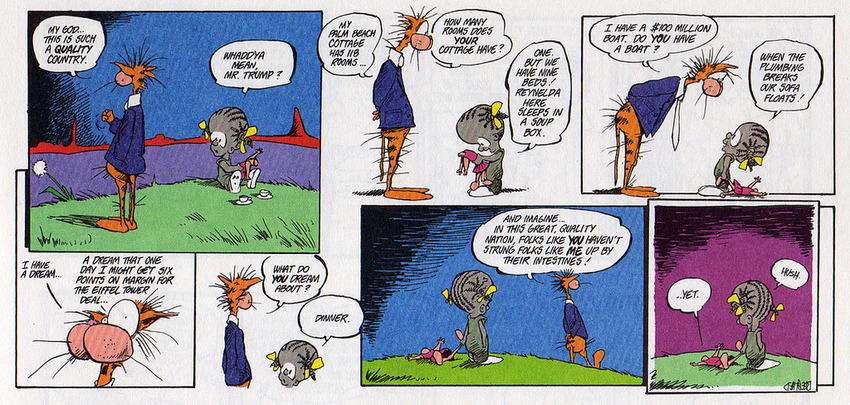
The timing of his return can't be coincidental. And if I had to guess, it has to do with Donald Trump.

One of the main long-running stories that emerged in Breathed's comics centered around the brain transplant of Donald Trump into the body of Bill D. Cat, the gross, anti-Garfield tongue fetishist. (And possible proto-Hodor: his vocabulary consisted of Ack! and Thbbft!)

"Billthecat". Licensed under Fair use via Wikipedia - https://en.wikipedia.org/wiki/File:Billthecat.jpg#/media/File:Billthecat.jpg
Yeah, there's a lot of sophomoric humor. Maybe that's why I love it so.

Anyway, it's interesting to see Bill transform from bizarre cat to, well, Donald Trump in a cat's body. But between the laughs, there's some good commentary. I still remember this comic.
http://welcometoyouredoom.tumblr.com/post/104760707206
Welcome back, Berkeley Breathed. This might be just a way to fund your powerboating habit. But maybe, just maybe, you see that there is a need for your type of satire.

Friday, June 19, 2015

Charleston

Something had been bugging me about the coverage of the nine murders at Charleston Emanuel AME.

At this time, it seems pretty clear that the shooter was motivated by white supremacy, that he went out of his way to target this specific church because of its tremendous legacy, that he had been forbidden to purchase a weapon because of a pending charge, and that he still had access to at least one weapon. Furthermore, the Confederate flag still flies at the statehouse, but not over it, and will likely not be moved to half-mast.

All of this is documented reasonably well.

But what I return to, over and over again, is how that prayer group welcomed him, allowed them to join, and prayed together.

Faith, especially a faith of redemption, doesn't give people superpowers. If anything it makes people more trusting, more naive, more oblivious to warnings.

It is easy to say

"They should've been skeptical!"

"Why would a white boy show up there?"

and, I'm sorry to see some have even said,

"Innocent people died because of his position on a political issue" [voting against a law that would have permitted gun owners to bring concealed weapons into public places, including churches]

They were armed better than you or I know.

The pastor, Clementa Pinckney, appears to have been a young, healthy man. He didn't pull out a gun. He didn't try to tackle the shooter.

He talked to him. Even in the midst of such carnage and immediate danger, he tried to appeal to this man.

Now, some will say that this was a mistake, that perhaps he should've fought.

Perhaps faith made him more vulnerable.

But isn't that what faith is? Vulnerability?

Faith, for many, is about security, about certainty, about conviction. But it doesn't promise outcomes. The people gathered in that prayer meeting had lives that spanned several decades. They had seen history. They would have had to be blind not to know that what made them great made them a target.

They still welcomed him.

Maybe I wish that things had happened differently, that these nine people -- ten, even -- were still alive, able to do the works great and small that made them a community. Maybe they should have been more careful.

The only thing I know is that they had a welcoming, trusting, spirit that escapes my understanding, which I can only ascribe to a faith I cannot share, but appreciate nonetheless.

There are many stories written into this tragedy: terrorism, racism, gun violence. But there is also faith -- not in a distant God, but in other humans, that caused them to open the door, to welcome, and to appeal, to the very end, for the triumph of goodness over evil.

Now it's time for us to be worthy of that faith. What will we do?

Thursday, June 18, 2015

Vroman's Bookstore

I'm a book hoarder.

Note: this doesn't mean I'm well-read. People seem to have that impression. The secret is that I talk about the same three books I've read all year. I'd like to think it's because they are good enough books that they have application to a wide range of circumstances or situations. But maybe it's because I'm a charlatan and a fraud in the knowledge cannery.

I stopped by Vroman's Bookstore, an independent bookstore in Pasadena, in part because I needed something to do in Pasadena, and in part because I now live in a bookstore desert. (The nearest Barnes and Noble stores are in Glendale and Fullerton. All others, including the one in Old Town Pasadena, have shuttered.) A student entering 9th grade needed a copy of The Glass Castle. (Her choice for summer reading -- she and her brother are pretty impressive.)

As I was browsing, I noticed these small laminated cards containing handwritten recommendations from staffers. I noticed that someone named Rafael seemed to have the same taste in US biographies. Curious, I inquired as to his disposition, both spatial and temperamental.

"Um, excuse me. Is Rafael working today?"

"Yes! He's in the back room."

"Does he ever work the floor?"

"Nah. He's the only one that requests to work in the back."

This sounded promising. The guy with tastes similar to my own seemed to be an antisocial troglodyte.

"Um... could I speak with him, if he's not too busy? We seem to have the same tastes in books."

"Sure!" *calls him up* "Oh, by the way, he teaches history at ELAC (East Los Angeles Community College."

For a moment I had that sinking feeling that I had in academic settings in which I demonstrated tremendous intellectual inferiority. I had a flashback to that time when I suggested Robert Kagan, a neoconservative, was writing as a liberal, which earned me the incredulous glance of the otherwise unflappable Professor Andrews. Or that time I asked a question, and had Professor Chen suggest, in front of my entire graduating class, "It looks like someone didn't read the book!"

Then I remembered: I'm a grown-ass man with money in an American store! I can be as ignorant as I damn well please! Emboldened by the pocket bulge of a wallet, I greeted Rafael with a vigorous handshake.

As it turns out, he was friendly and weird in that sort of academic way. We chatted about the relative merits of a biography written by a historian as opposed to a newspaper columnist, about accusations concerning Hamilton's heritage, and whether or not the new Nixon biography would live up to expectations. ("A lot of books written by journalists get a lot of attention, but they end up being surface rehashes of things already known.")

And so, I paid retail, hardcover prices for two books.

Reagan: The Life
, by H. W. Brands

The author, according to Rafael, has conservative leanings. "If you're left-wing, you'll probably hate it." I took that as a challenge, though I suppose even if I hate it, it will make a welcome gift to my cousin. If nothing else, I am curious how Edmund Morris, the outstanding Theodore Roosevelt biographer, foundered on this subject.

Being Nixon: A Man Divided, by Evan Thomas.

Although Rafael had this book in mind when commenting on "rehashing known material", I found drawn by the Fresh Air interview too compelling....

wait, did I get the wrong book?

Argh.

Well, at least I still have the receipt somewhere.  The perils of shopping with a dead smartphone.

Anyway, this is probably going to be a difficult summer as far as reading is concerned. I'm probably open to suggestions, although there is perhaps no insult quite as specifically annoying as a rebuffed/ignored book recommendation.

Unforced errors aside, I liked this aspect of Vroman's. Makes me wish I was part of a book club.

Friday, August 1, 2014

Review of Destiny of the Republic (James A. Garfield bio)

The time you won your town the race,
We chaired you through the market-place;
Man and boy stood cheering by,
And home we brought you shoulder-high.
To-day, the road all runners come,
Shoulder-high we bring you home,
And set you at your threshold down,
Townsman of a stiller town.
Smart lad, to slip betimes away
From fields where glory does not stay
And early though the laurel grows
It withers quicker than the rose.
Eyes the shady night has shut
Cannot see the record cut,
And silence sounds no worse than cheers
After earth has stopped the ears:
Now you will not swell the rout
Of lads that wore their honours out,
Runners whom renown outran
And the name died before the man.
So set, before its echoes fade,
The fleet foot on the sill of shade,
And hold to the low lintel up
The still-defended challenge-cup.
And round that early-laurelled head
Will flock to gaze the strengthless dead,
And find unwithered on its curls
The garland briefer than a girl's
.

- A. E. Housman, "To An Athlete Dying Young"

tl;dr:

"You either die a hero or live long enough to see yourself become the villain." - Batman, The Dark Knight

As a child, I loved reading about the presidents. In second grade, I had a book that provided a two or three page description of each president. There was also a wonderful series of books that covered each president separately, though our school library only had Jefferson, Jackson, and a couple others. I memorized the terms and order of the presidents, and knew who died in office and was assassinated. The only thing I knew about James A. Garfield was that he was assassinated by an office seeker, followed Hayes, and was followed by Arthur.

He was shot four months into his presidency, and died two months later. Can we be blamed? He appears in that interregnum between Lincoln and Theodore Roosevelt, where we suspect the presidents were crappy and America was particularly corrupt.

I just finished Candice Millard's book, Destiny of the Republic, and I can safely say that, with the possible exception of William Seward, he might be the most amazing American that history forgot. At least, he's one of the more remarkable and brilliant American Presidents. Theodore Roosevelt might have been more flashy, and perhaps rightfully has a stronger legacy. But Garfield might be more brilliant and, well, good.

Briefly, let me go over some of the amazing things Garfield did in his abbreviated, yet full, life.

His father died when James was two, leaving his mother and siblings to eke out a living on a tiny farm in Ohio. He was the younger brother, which oddly enough meant that it fell to him to go to school. (His older brother was needed on the farm.) He dropped out, became a canal man, and nearly died when he fell overboard one night. He decided it was a sign from Providence that he was meant for more. He returned home, and, with the family's entire savings of $17, went to a local, tiny, poor school known as the Western Reserve Eclectic Institute.

He paid his tuition by being the school janitor, and, admirably, didn't give a crap about who knew he was poor. He studied so hard, and so comprehensively, that he was promoted to assistant professor the next year. He ended up teaching classes in languages, philosophy, and mathematics, and was popular enough as a teacher that he expanded his teaching load. He went on to graduate from Williams College, and returned to teach at Western Reserve. He became its president at 26. He became a state senator, but then joined the Ohio milita.

With no military training, no artillery, and commanding an inferior force, he won a decisive victory against a seasoned Confederate general, who had graduated from West Point. This victory kept Kentucky in the Union. He recognized the need to be more aggressive well before the Union leadership.

He became a Congressman, and became known as an honest broker and an unmatched orator. While a member of the US Congress, he penned an original mathematical proof.

There's a lot more. I recommend a read. Although I found myself occasionally wishing for something a bit less, well, emotionally manipulative (or maybe just stylistically like Edmund Morris or Doris Kearns Goodwin), Millard's book left me absolutely fuming at the medical malpractice of Dr. Bliss. (Spoiler: Garfield dies!)

*Postscript: I had started, and never finished, this review. Finishing it now in response to my recent post on McKinley.

Wednesday, August 21, 2013

A little faith

I think, somewhere over the last few years, many people have concluded that this country isn't worth saving. We haven't always done it publicly, or noisily. But, secretly, a lot of us sort of gave up.

It shows, too. In any relationship, it shows.

Somewhere along the line, we got more scared about our jobs, and felt like we had less time to worry about that of our neighbor.

At some point, we became more calculating and less trusting -- rationalized by the belief that that's what made individuals successful. Maybe it's even true. But it's not how a nation becomes great.

There are those of you who are itching to say that America never was that great -- that the hagiography of decades past is part of the national delusion that got us into this mess. I'm inclined to agree. However, that's not at all inconsistent with the truth that a belief that we are, or can be, the shining city on the hill actually helps us to be better.

Perhaps most telling, we have someone else to blame. What about our contribution to the failure of the relationship? Blame is more important, easier, more comforting, and a hallmark that the relationship is dying.

And yet I'm strangely hopeful.

Maybe it's historical perspective -- as crappy as we are to each other now, we have only to go back a few years, or decades, or centuries, to reveal how truly shitty humans can be to each other.

It's actually better now, on average. It just doesn't feel that way.

I think in some ways, I understand how conservativism increases with age. As we get older, we remember how things were worse at the beginning of our lives. And yet, there is no sense of pride, or satisfaction, or even the barest sense of hope that comes from that knowledge. There's only the gnawing sense that this should've felt better, and that people keep demanding more, that the battles are often the same ones we fought (or were spectators to) when we were young and stupid and had faith.

I'm not sure where this blog post came from. I'm supposed to be thinking about a humorous speech for Toastmasters. But I think it comes from a slow, steady, and hopefully growing sense that I do have faith in this country, in its peoples and The People. Not much. But enough to keep going, and maybe do a bit more. I am too old to put my faith or reasons in broad ideas. It resides in specific people, in moments, in which the unreachable heights of idealism find their best, beautiful, and beautifully flawed expression.

I don't know whether it's better to thank people for loving me, or to thank them for helping me learn to love this country. Fortunately, there is tremendous overlap. It's for you -- and not a piece of paper, or dead Founding Fathers who, through death, are absent fathers -- that I'll try to remember whenever I start to lose faith, or become too complacent.

The picture of Bobby Kennedy is coming down. Or, at the very least, the pictures of people I know personally have to join him. I work for the living, not for the dead. And that's as pure a faith as I care to have.

Tuesday, March 26, 2013

Today is a good day to love


Today, our expectations are probably raised, perhaps prematurely, perhaps unrealistically, for the SCOTUS to resolve one of the great issues of our time in the manner in which we'd prefer. 

But our expectations should be raised, and raised now, for ourselves. We should love more completely, behave more responsibly, and be better at supporting and caring for both our friends and distant strangers -- unknown to us, except as human beings, which should be enough for us to do what is good and right.

I wanted to write some soaring polemic. But increasingly, I can't. And that might be a good thing. You've helped me as a human being grow beyond the love of abstract justice and care more about individual people, and how the laws of this country affect you. Your goodness to me has helped me grow from a homophobe to someone who cares more about this social justice issue than any other. 

Like any new convert, I've had to learn wisdom-- I can't bully or argue equality to my conservative religious family members anymore. I can advocate, gently. But I have to listen as well. It is difficult, even painful at times, but it is probably far less painful than perhaps some of the conversations some of you have had with loved ones. 

Here, love triumphs as well. Contrary to my fears, I haven't had to pick between them and you. And I think, if I were gay, they would still love me. It's perhaps small comfort to those of you dealing with Prop 8, but it's no exaggeration that I believed same-sex marriage and equal rights had the potential to split me from them.

So I have no expectations for the hearings today or tomorrow, or even the ruling in a few months. What I will expect of myself is to be somewhat more generous, somewhat more kind, somewhat more thoughtful to my LGBT kin. Some of you I consider family. It is time for me to behave like family, and let you know, more regularly, and more clearly, how much you are loved -- not as a cause, but as a person.

Wednesday, March 20, 2013

FDR Campaign Address at Detroit, Michigan, October 2, 1932

This is, by far, a timely find. I was searching for some FDR quip when I stumbled across this.

http://www.presidency.ucsb.edu/ws/index.php?pid=88393

Read it, and be amazed, as I am, how it applies, verbatim, to today.

Tuesday, February 19, 2013

Science fiction, Ender's Game, and the nature of art


An excellent article:

Before he became a voice of the American right, Orson Scott Card wrote a really good book.

I wasn't aware of the controversy surrounding Orson Scott Card when he gave the 2003 commencement speech at Harvey Mudd. At the time, I hadn't even read Ender's Game. But I did read it, eventually, and loved it -- it rivals Dune as my favorite science fiction book of all time. (Sorry Foundation, but I think you'll be stuck with third billing.) It even made my 15 most influential books list. (Dune is absent.)

I am a firm believer that all good science fiction illuminates something about us as human beings. Often, it tricks us into thinking about psychology, or philosophy, or justice. It dazzles with an exotic setting or technology, or even different rules of physics, to get us to suspend our disbelief. And with that belief suspended, with our defenses lowered, we can more honestly look at ourselves, our societies, and our past than in any other art form.

Disarmed, we learn, even as we are treated to a fantastic story.

So it is with Ender's Game. How else could we view children as potential murderers? When I read A Long Way Gone: Memories of a Child Soldier, I brought along all my mental baggage and assumptions about Africa, foreign conflict, resource wars, and recent world history. And as well-written and powerful as it was, I wasn't fully able to immerse myself into the world of war-torn Sierra Leone, as seen through the eyes of a child. It was still a bit alien to me, because it was real.

But in Ender's Game, it seems more plausible, almost natural that the selection process and jealousy inspired by Ender's rise would lead to murderous impulses. And it seems equally natural that Ender, a fundamentally good boy, would kill, twice, to protect himself. It also seems plausible that adults would manipulate the circumstances to force this test of his mettle -- because we knew, as children, how adults manipulated us all the time, and not always for our own benefit.

So it's tragic, but it's true: I can better empathize with this boy in a science fiction novel than a real boy in the real world telling me about the real horrors of war.

Ender's Game treats children as equal to adults. The children are bright; sometimes, they are brighter than the adults. They learn, adapt, and strategize. They engage in war games, and, as we find out, real warfare. They feel emotions that are sometimes as sophisticated as those of an adult.

The sci-fi elements also help break down that wall between child and adult. In zero-g, standard measures of strength and size matter less, and a child can be the equal of an adult in combat. Those of us who read the book remember vividly the scene where Ender shouts triumphantly at Graff in the zero-g room. "I beat you! I beat you!"

But Graff held the wand that unfroze Ender. It was impossible to beat the adults.

And that is how they remain children. Unlike a lot of lesser children's literature, it doesn't make kids adults, or make the adults kids. The children of Ender's Game are capable and brilliant. But they are still subject to the control of adults. The adults determine their lives, even as those same adults place the fate of humanity in the hands of those same children.

***

So what about the politics of Orson Scott Card? Should that color how we view this book? How can we enjoy it fully if we know that this man campaigns actively against the identity of some of the same children who find, in his book, some strength and security from the complexity and hostility of real life?

For this the tragedy of Ender's Game. Or, it is the triumph of that book to transcend its author and become something else.

Ender's Game means a whole lot to precocious, nerdy children. I didn't have the privilege of finding this in my youth. But a lot of my Mudd friends did read it as children and young adults, and credit it for being both entertaining and inspirational. Some said it helped them deal with the ways adults usually treat children, especially bright, precocious ones.

And, yes, some were gay.

How ironic that it helped gay men and women, bright as hell, deal with misunderstanding long enough to break out and become who they were meant to be!

Except that it's not ironic at all: that's how art works.

Sometimes, a book (including That One), can become agents of change in ways directly contrary to the author's intent. That's what happens when art is created. It no longer belongs to the artist -- it belongs to us. All of us. (Especially That One.)

Ender's Game now belongs to my gay friends, and there's not a damn thing Orson Scott Card can do about it.

Tuesday, February 12, 2013

Grand Unified Theories

Remember? I'm no longer a scientist. This isn't about physics.

When I was young, I thought people were fundamentally the same. But I didn't really understand well why people did what they did. So, through some classes and independent reading, and with the passion of a lonely only child, I devoted some of my life to trying to figure people out. Why do people do what they do? Why do we feel what we feel? Or, screw everyone else -- why the hell do I do the things I do?

I think, at some point, the allure of the questioning wears off. It stops feeling deep. It stops feeling meaningful. Instead of feeling like thoughtful scholars in a college lounge, contemplating existence over some wine (or other substances), it starts seeming like, well, something drunk or high wastrels do when they are drunk or high.

But more than that, we decide what people are. Experiences, positive and negative (but especially negative), shape our beliefs on human nature. That, in turn, shapes our beliefs about our social, political, economic, sexual, and religious lives. We decide what we are, and who we are -- and more than that, we decide who everyone else is, too.

We decide people are inherently good, or inherently evil. We decide whether those on welfare need it, or are moochers. We decide whether people of other traditions are an opportunity for growth or a threat, or both. We decide, more or less, how much to worry about the past, the present, and the future. We decide whether obstacles make people stronger or are discriminatory. We decide whether or not men and women and unborn babies deserve death.

And we decide that it is true for everyone, or at least enough people, for it to guide our behavior.

I've been looking for that grand unified theory of human behavior. It started with a bit of religion and philosophy. Then a bit of history. Economics was a key component. I stumbled across some sociology and psychology.

But it didn't get more simple. Unlike what we expect for good theories in the natural sciences, sociological theories don't get more elegant, more predictive, more powerful. They get diffused in detail and case-based evaluations. It's not because human behavior is endlessly complicated -- I sincerely doubt that. A

nd I have no idea why the hell it isn't like that.

For whatever reason -- complexity, some mathematically chaotic process, or shitty analysis -- we don't have a grand unified theory of humans.

And I don't think we're going to get one.

Even more importantly, I don't think we need one.

The belief that there is a unified theory is literally killing us.

It is the belief in the existence of universal truth, and the need to enforce that truth above others, that is the root of our religious and ideological warfare. It is the belief in a commonality that ignores different environments, and the potential for simple unpredictability, that have led us to make horrible foreign policies, often, in America's case, based on what is empirically false assumption that all all of us -- leaders and citizens alike -- are essentially after the same things, and that any gaps are due to misunderstanding that is bridgeable by better communication, empathy, or argument.

It is the belief in a universal truth -- simplicity where there is none -- that has caused our economic policies to be dictated by ideology than empiricism. If the free market is right, it has to be right all the time. If Keynesianism is right, it has to be right all the time.

That's total nonsense, especially when we look at the assumptions -- stated or implied -- that have to work. For example, neoclassical economic policies work given certain conditions that preclude market failure -- information, zero transaction costs, negligible barriers to entry, etc. Even if the conditions aren't perfectly met, they work pretty well a lot of the time (assuming the goal is, say, total GDP, instead of equally shared wealth -- another assumption). Keynesianism economic policies work pretty well when markets aren't working like "normal", or when labor has information about wages of coworkers (and fear of losing the job is less than fear of falling behind). Behavioral economics builds in even more psychology -- though, as it acknowledges itself -- there are different regimes for human thinking and analysis that make a universal model problematic. (You can throw in more coefficient weightings, but at some point it becomes an empirical model, not a theory.)

The absence of a theory doesn't excuse ignorance. We should all know neoclassical AND Keynesian AND Behavioral and perhaps even Hayekian economics -- the assumptions, the implications, and limitations of each "school". We should be able to articulate why we cling to one view or another, and be honest whether our preferred perspective of human nature might not be confirmed in a given situation.

Most of us might not have the time and inclination to carry around nearly innumerable bits of knowledge about cognitive biases, biological-behavioral relationships, sociological models, persuasion tactics, and religious traditions and send some observationally/empathetically derived metaphorical punchcard into the poorly-coded mess of our own minds.

Even if we actually did all this, it might not be worth it. Life is meant to be lived, and some mistakes are a lot more fun than we think. (See: Shitty Dates).

So maybe most of us don't have to. And that makes us no different than where we were, except for one thing:

We embrace the humility that we don't have a grand unified theory, that there might never exist one, and that it's toxic and maladaptive to even believe that one exists.

In other words, go ahead and worry about why your partner/friend/relative/boss is so fucked up and different. But, even if you figure them out, don't count on getting much stuff to be used elsewhere.

You're welcome to try -- especially if you're a therapist, pastor, forensic psychologist, politician, or someone else for whom, I suppose, it's important to see patterns in human behavior. I know I'll keep playing armchair economist and sociologist, just because it's fun and makes me feel like I've got stuff to say that is worth listening to (despite considerable evidence to the contrary).

But I suspect we'd be a lot happier and better at life if we just worked on our relationships with specific individuals, and assume whatever successes or patterns we discover work only for them. That just might keep us out of trouble, and make us better human beings to each other.

Friday, February 1, 2013

Rand Paul believes Obama is the "worst president ever"

I've noticed a number of conservative ads popping up in my FB feed. One of them is an ad for Senator Rand Paul, claiming that Obama is the "worst president ever".

Really?

I was already disappointed by your complete lack of self-deprecation in attempted comedy at the Radio and Television Correspondents Association dinner. (Anthony Weiner was nearly as bad.)

I thought you were kind of a prick about a routine patdown at the Nashville airport. Yes, I get that you're a libertarian standard bearer. But a patdown isn't a police state. And that you made such an announcement after it happened to you -- it's been going on for quite a while -- is at best opportunistic showmanship and, perhaps less charitably, a self-centered, selfish view on personal liberty. I'm willing to grant the more charitable possibility, because you appear to have been consistent -- wrong, but consistent.

But "worst president ever"? Do you even know American history?

Are you aware that Grant basically took bribes during his presidency?

Are you aware that Teapot Dome scandal crippled the Harding administration and brought down several cabinet members?

Are you aware that, despite generally being a remarkable President, FDR presided over the largest forced relocation of American citizens in the 20th century that disrupted hundreds of thousands of lives, including those of my grandparents? Or tried to pack the Supreme Court?

Going back to the 19th century, are you aware of the Trail of Tears? What about the causus belli of the Mexican-American war?

Are you aware of American imperialism in the early 20th century, or the middle 20th century, or the late 20th century?

Are you aware that Kennedy behaved very dangerously and recklessly toward Cuba and general US-Soviet relations in the Bay of Pigs, the assassination attempts, and the Cuban Missile Crisis, and campaigned on a fake missile gap that Eisenhower did not argue against because it would reveal the extent to which America was able to monitor Soviet activity?

Are you aware that Johnson pushed an escalation in Vietnam even after it became evident that the Gulf of Tonkin incident was due to erroneous sonar readings and jittery nerves, and not a Vietnamese attack?

Are you aware that, during Ronald Reagan's presidency, the debt was a higher proportion of GDP and expanded far more rapidly than this current one? Also, do you remember Iran-Contra?

Uh, WATERGATE?

Now, I don't have reason to question your intelligence. After all, your father is a longtime Republican representative from Texas, and you have the blessings of a privileged upbringing, complete with a good education.

But I am left with an unpalatable choice: either you don't know these things, and are guilty of gross ignorance of American history, or you do know these things, and are just cynically ignoring them to make your political points and fight your political battles.

Again, I feel charitable, and am willing to go with the latter, which makes you a douche, not a moron. Congratulations.

Now a rhetorical post with an empty chair doesn't really matter that much -- Rand Paul doesn't give a shit about what I think, and I don't give a shit about what he thinks. 

What does matter is that I find he is influential in the belief system of a number of people I know and appreciate. And not all of those people may have the blessings of a solid history background, or at least historical perspective.

Proportionality is important. "Worst" is a high threshold -- it means that, in sum total, that Obama is more corrupt, more ignorant, more incompetent, more malicious, more dictatorial, more violent, and more fiscally irresponsible than all of his predecessors. 

All of them. 

Men who were not bound by a large and mostly free press. Men who did not have to deal with modern communications technology and information disseminators. Men who owned slaves. Men who authorized the use of the US Army against unarmed civilians (see The Bonus Army), which, as a close student of law, you would know is (or at least was) particularly illegal. Men whose religious faith informed their foreign policy views and whose legacy still poison our policy with their particular brand of Presbyterian messianism. 

Proportionality is the first thing that jumps in my head when I hear people argue about Benghazi, or Fast and Furious, or federal debt, or Solyndra, or any of the other charges leveled at this president. 

It hasn't been a perfect presidency. And there's some blame that needs to be owned, and probably is. The case of Shirley Sherrod was a horrible, horrible mess. Guantanamo is still open. Gays and Latinos feel rightly disappointed that what they thought they were getting was not quite what they got, in the form of gay marriage/DADT and immigration reform, respectively. I think this is partly due to unmanaged expectations, but partly due to some real lost opportunities and poor trade-offs.

Benghazi was one consulate attack; there were seven attacks on embassies, consulates, and other major diplomatic missions under George W. Bush. I don't remember anyone raising an outcry then that the deaths of five, or ten, or a hundred people invalidated the Bush doctrine. I already wrote my thoughts on Benghazi here.

Debt has gone up because revenues have gone down, and not because spending has increased appreciably. And in the near-term, it's the right policy -- raising taxes or cutting spending is bad for the economy, and short-term growth is, given the current bond market and the European experience, generally a good idea.

Fast and Furious is a serious matter. But does it deserve this proportionate response? It's not Iran-Contra, either in its scope or its breach of American laws.

Solyndra is being investigated, but at this point, it looks like a way to attack government support of [non-ethanol based] alternative energy without attacking alternative energy directly.

The problem for many conservatives is that Obama's administration, oddly enough, has been an odd combination of competent and lucky. The raid for Osama Bin Laden could have gone down like the botched Tehran embassy attempt that basically killed Carter's reelection chances. Attacks against Somali pirates could have gone more poorly. The Libya campaign could have resulted in combat casualties. There have been no major terrorist attacks on the homeland. The Republican leadership has proven poorly equipped to effectively engage with voters and to manage its own radical elements. 

I think it's precisely because things have worked pretty smoothly that we get histrionics about things that are important, but not as significant as the outcry warrants. We are arguing louder about smaller things, and small politics by small people have diminished all of us.

This post has already gone on too long, but in short, here's what I'd like to say to my libertarian friends: it's damn good to be concerned about civil liberties. It's damn good to investigate drone strikes, or extrajudicial killings. "I may not agree with what you say, but I'll defend with my life your right to say it."

But if you want to be taken seriously, bear in mind the principle of proportionality. I saw a lot of madness leading up to the election, and it hasn't completely gone away. I'm open-minded, but I'm not a masochist, and will not suffer ridiculousness indefinitely.


Friday, January 11, 2013

The history of cheating at cards: FDR and the war

(From No Ordinary Time: Franklin & Eleanor Roosevelt: The Home Front in World War II, by Doris Kearns Goodwin, p. 159-160)

The 76th Congress had been a tumultuous gathering. So trying were the conditions, observers noted, that, just after the final House vote on conscription, Speaker William B. Bankhead died of a stroke. (He was replaced by Sam Rayburn of Texas.) But in the end, despite the blunders, divisions, and dillydallying, the Congress had granted the president the legislation he needed to begin the process of mobilization, and with it the revitalization of the American economy after a decade of depression.

It was the president's custom each year on the night that Congress was due to adjourn to host a poker game in his study. The game would begin in the early evening, and then whoever was ahead at the moment the Speaker called to say that Congress had officially adjourned would be declared the winner. On this night, Morgenthau was far ahead when the Speaker phoned, but Roosevelt pretended that the call was from someone else and the game continued until midnight, when Roosevelt finally pulled ahead. At this point, Roosevelt whispered to an aide to go into another office and call the study. When the phone rang, he pretended it was the Speaker and declared himself the winner. Everyone was in high spirits until the next morning, when Morgenthau read in the paper that the Congress had officially adjourned at 9 p.m. He was so angry that he handed in his resignation. Only when the president called and convinced him that it was all in good fun did Morgenthau agree to stay. Morgenthau should have realized that Roosevelt was not above a little deception if it helped him win his bets!

Tuesday, January 8, 2013

Homosexuality and the Boy Scouts of America


CNN: Gay Scout's request for Eagle rank rejected

These cases are often more complicated than first appears, so I'm willing to accept that the BSA may have rejected an application for other reasons. So I will tread very carefully here.

I attended an Eagle Scout induction recently. It was impressive; I am told that not all can be expected to be like this, as parental involvement plays a huge role in the scope and majesty of the induction ceremony. It did strike me as a bit more martial than I expected, which was a bit unnerving. And the Scoutmaster's Minute was clearly delivered by someone who was on the wrong side of the election and sounded overly apocalyptic about how this scout was part of the "last line of defense" against American collapse. 

But it was impressive to meet a host of young men -- based on names, many of them Muslim -- with a variety of accomplishments. All the boys, to a one, were unfailingly polite and helpful. And I gained a new respect for this young man, who I honestly did not know as well as I thought I did. To be an Eagle, you have to complete, among other things, something like 120 (or 180?) nights of camping, a major service project, and a host of other things.

The BSA have, of course, been rocked by the scandal involving pedophilia and their internal database on reported cases. And the gay issue is not new. What may be new is that a majority of Americans might support either a change in policy, or the creation of a more open version of the BSA-- maybe one that enables young women to rise to the equivalent of eagle scout.

I don't think reform would happen anytime soon. I doubt it would effectively come from outside pressure; all that could happen is sufficient numbers of lawsuits could cause funding problems and the closing of some or all of the organization, which would be a huge waste. Reform would have to be grass-roots, and involve some rather precocious organizing by teenage boys, not particularly known for their autonomous political activism. (Somehow, I don't see it as coming from the parents, and definitely not from the scoutmasters.) 

Perhaps the coming out of prominent men who are also eagle scouts would help-- imagine the impact of a Jim Lovell coming out and encouraging the BSA to change its policies.

A side note: the induction ceremony I attended took place in a UCC church. The first thing one would notice, even before walking through the front doors, was a big table draped with a rainbow flag with some LGBT material. I thought it was fitting, somehow, that everyone in attendance would register at some level an awareness that the troop was a guest in God's house, and, in this house, the LGBT community was not just welcomed and embraced as fully equal-- they're family, family worth fighting for.

Monday, December 24, 2012

'Twas the Night Before Cliffmas

'Twas the night before Cliffmas, when all through the House
Not a creature was stirring, not even a louse.
The committees, hamstrung by the dimwits' despair,
In hope that St. Norquist wouldn't be there.

Cantor and Price nestled all snug in their beds,
While visions of Speakership danced in their heads.
Obama with Blackberry, and Reid with his trap
Had just settled their brains for this partisan crap.

When out in the markets there arose such a clatter,
Traders sprang from the bed to see what was the matter.
Away to the terminal those trades like a flash,
Tore open the pensions and burned up our cash.

Lobbyists on the breast of the Washington ho
Gave the lusty noon quickie to citizens below.
When, what to their wandering eyes should appear,
But a sleigh of hand, and eight shifty financiers.

With a little old driver, so frothy and sick
I knew in a moment it must be that prick.
More rapid than vultures his backers they came,
And he whistled, and shouted, and called them by name.

Now Adelson! Now Scaife! Now Perry! Now Koch!
Now Perenchio! Now Rowling! Now Griffin! Now Loeb!
To the top of the donors! With unmitigated gall!
Now go to hell! Go to hell! Go to hell all!

As vomit flows before the pissed drunk heaves dry,
When they meet with an obstacle, they mount an ad buy.
So up to the House top the donors they flew,
With the sleigh full of pledges, and St. Norquist too.

And then, in a twinkling, I heard on Fox news
The prancing and pawing of each of those spews.
As I threw up my lunch, and was turning around,
Down the Beltway St. Norquist came with much sound.

He was dressed all in fire, from his head to the sod
And his sickle all crusted by moderate blood.
A bundle of pledges he had flung on his back
And he looked like a dickhead, and spoke through his crack.

His eyes how they frowned! his donors how scary!
His cheeks were like Brillo, his body like (old) Drew Carey!
His mad little mouth was drawn with some words
And the spittle of his chin was as white as bird turds.

The stump of a dogma he held tight in his teeth
And the smoke it encircled policy like a wreath.
He had a mad face and a hatred of babies
And shook when he raged, like a raccoon with rabies.

He was chubby and plump, a right prickish old git
And I cried when I saw him, and my pants did I shit.
A twitch of his eye and a twist of some heads
Soon gave me to know all had much to dread.

He spoke tons of words--would his plan work?
And filled all the op-eds, and threw bombs like a jerk.
And laying his knives aside the country's throat
And giving a nod, on Sunday shows to gloat!

He sprang to his perch, to his team gave a whistle,
And away they all flew like the screeching Nazgul.
But I heard him exclaim, 'ere he drove out of sight,
"Happy Cliffmas to the poor, and to all, FUCK YOU, I'M RIGHT!"

Saturday, November 24, 2012

Petition to the Obama Administration to Require a Facebook Dislike Button

https://petitions.whitehouse.gov/petition/require-facebook-provide-dislike-button/Zx9pBT4L

Here is the text for the lazy:

WE PETITION THE OBAMA ADMINISTRATION TO:

Require Facebook to Provide a Dislike Button

Facebook has ignored petitions for a dislike button. As the prime social networking platform, it should better comply with the First Amendment, which protects free speech and respectful dissent.
Facebook finds a dislike button valuable enough to use internally, via Push Kharma, to provide feedback to its software engineers.
Here is why an opt-out dislike button is needed on Facebook.
1. It lets users express disapproval easily without being offensive.
2. A dislike button lets users distinguish between posts with little interest and controversial posts.
3. It works well on other websites.
4. Facebook accounts are not anonymous. Users are more accountable, making it less likely it will be abused.
5. An official button will destroy the demand for malware dislike button imposters.