After much tearing of clothes and gnashing of teeth, I'm actually, finally, going to Northern California for a short vacation. Headed to Fremont and Garberville. Fremont should be familiar to most of you -- it's Bay-area ish. Garberville is in Humboldt County. My cousin there is a "pharmacist",y which I mean she is actually a pharmacist, perhaps the only legitimate one in the area.
This has been an... interesting 24 hours.
First, my departure time. For whatever reason, I thought it would be a good idea to leave Monday evening. My septagenarian aunt can make the trip to Fremont in one day, but I thought I might need two. The initial "plan" (scare quotes appropriate in this case) was to spend the night around Fresno, spend the day in Yosemite, and the head to Fremont for dinner. But just as plague changed the course of human history, it changed the course of this human's story.
I guess you could say
(•_•) / ( •_•)>⌐■-■ / (⌐■_■)
The trip got off to a bumpy start.
So the " "plan" " became "head up I-5 until you get tired. I had to pull over after an hour because I had to field some questions about O. Henry's use of vocabulary in "The Gift of the Magi". The student is in 9th grade honors English -- but it's pretty tough. Solid vocab chops and a healthy appreciation of puns are needed. I'm actually pretty proud of how I was able to explain, and the student was able to understand, how the author uses beggar as a verb, and why it's funny. Explaining jokes is never a surefooted endeavor, but I managed to not shoot myself in the foot, or put said foot in my mouth, and the mother's offer for compensation for remote tutoring effectively that someone else would foot the bill for the hotel tonight. (O Henry? I don't owe him anything!)
So here's where it gets interesting. I got a text around midnight from the brother of that student indicating he needed help on his first calculus assignment. On that auspicious note I pulled off at Gorman and into a closed McDonalds lot to send off some texts.
A guy approached my car and asked, "Hey, can you roll down the window?"
I stared at him for a good second or two, and obliged.
He then tells me a story about how he and his buddy got stranded on their dirtbikes. I'm glad I checked my cynicism for half a second, because he seemed to be asking for more than a couple bucks for gas. He wanted a ride.
His name was Dante. I suppose a more bemused deity might've sent a Cain.
Now, prior to the trip, I did stop by at the library and picked up some audiobooks. Among the offerings was Malcolm Gladwell's Blink. I didn't take it, because I had read it a few years ago. But I suppose the principles he was outlining were operating, because I said yes before I really had processed anything.
He got in, and we started driving toward a dark, dead-end street, to "meet his friend guarding the bikes". I mentally thought, "Okay, this is going to be interesting."
As it turns out, Dante took over watch duty of the bikes. Ricardo and I ended up driving to their car, which, as it turns out, was about ten miles away over rough roads. It was then that I was able to realize why I had trusted Dante enough to give him a ride. If I'm honest, these were factors:
1. seemed clean-cut, middle-class
2. white
3. offered me money for help
4. I was by myself, and so the direct consequences of robbery/murder would be limited to me.
But perhaps the most important one: he actually had on all the protective gear. Either he was who he said he was, or he was a serial killer particularly committed to playing the part. I respect method actors.
I got to know the two guys a bit. They each have a strong internal locus of control. Ricardo had been in a terrible accident in 2009. A drunk driver had nearly killed him. Doctors warned him against pushing his body too hard, but he found that surfing, dirt biking, and rock climbing were better than Percocet. Ricardo was now a civil engineer for a private water company in Ventura. I knew less about Dante's background, but he had been in the army and had used his navigation skills to help them get out. (Ricardo's bike had started breaking down and a trip that had been planned for five hours turned into a fourteen hour ordeal.)
Through it all they had no fears of dying in the desert, either from biking itself or exposure. They had conserved their water, and had topped off their gas tanks. Before Ricardo's bike had started breaking down, they had been taking trails that involved tight turns exposed to 60-foot drops. Ricardo had tried to jury-rig a solution, but found that the bolt in his shifter had practically fused.
He calmly said, "I knew I wasn't going to die. If we had been trapped overnight, I would've dug a hole to help keep warm." They did have their phones, but had held off from calling 911. (The ranger station had closed at 5pm.)
Ricardo had said that another guy who usually joined them had declined to go today, as a mutual friend had died dirt biking the day before.
I happened to have two peaches in a cooler, and gave it to them. They were grateful. They offered me money again, but I just gave them my card. Somehow, I felt it would be good for me to stay in touch with them.
Hours later, I finally checked into a motel, where I had paid twice as much as I had expected, and where I found WiFi problems that compelled me to squat in the lobby at 5 in the morning. I started whining, furious that I was working on student questions, furious that the blase night receptionist was spraying for roaches in the lobby while I worked, and generally tired and pissed.
Then I thought, goddamn it, Ryan. You don't really pay attention to what goes on around you, do you?
Tuesday, August 18, 2015


Monday, July 13, 2015
Opus is Back
 |
| https://www.facebook.com/berkeleybreathed/photos/a.114529165244512.10815.108793262484769/1004028256294594/?type=1&pnref=story |
It's been 8 years since he last published a comic.
He's the creator of the Bloom County, Outland, and Opus comic strips. The comics cover the adventures of a band of misfits, and center around a jovial and neurotic penguin, Opus.
While Bill Watterson's Calvin and Hobbes informed my philosophy, and Jim Davis' Garfield shaped my precocious pessimism, Breathed's Bloom County served as a political/current events primer. This was especially useful/weird for a kid who didn't discuss politics at home. Who was this C. Everett Koop, and why is it funny that he gets killed by tofu and bean sprouts?
The timing of his return can't be coincidental. And if I had to guess, it has to do with Donald Trump.
One of the main long-running stories that emerged in Breathed's comics centered around the brain transplant of Donald Trump into the body of Bill D. Cat, the gross, anti-Garfield tongue fetishist. (And possible proto-Hodor: his vocabulary consisted of Ack! and Thbbft!)
 |
| "Billthecat". Licensed under Fair use via Wikipedia - https://en.wikipedia.org/wiki/File:Billthecat.jpg#/media/File:Billthecat.jpg |

Yeah, there's a lot of sophomoric humor. Maybe that's why I love it so.
Anyway, it's interesting to see Bill transform from bizarre cat to, well, Donald Trump in a cat's body. But between the laughs, there's some good commentary. I still remember this comic.
Welcome back, Berkeley Breathed. This might be just a way to fund your powerboating habit. But maybe, just maybe, you see that there is a need for your type of satire.
Anyway, it's interesting to see Bill transform from bizarre cat to, well, Donald Trump in a cat's body. But between the laughs, there's some good commentary. I still remember this comic.
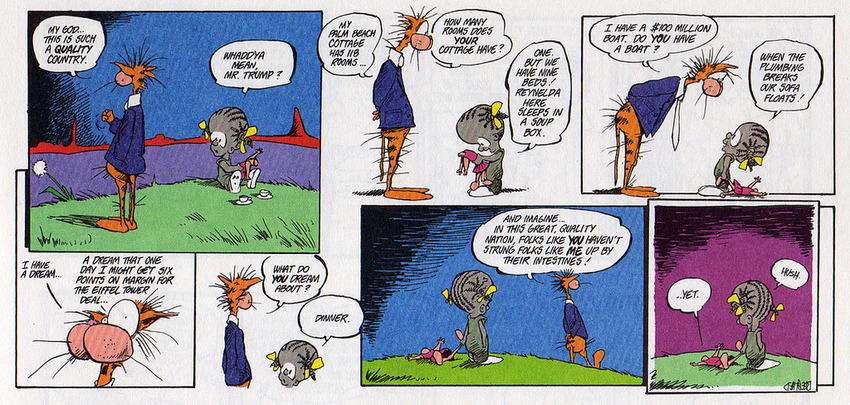 |
| http://welcometoyouredoom.tumblr.com/post/104760707206 |
Friday, June 19, 2015
Charleston
Something had been bugging me about the coverage of the nine murders at Charleston Emanuel AME.
At this time, it seems pretty clear that the shooter was motivated by white supremacy, that he went out of his way to target this specific church because of its tremendous legacy, that he had been forbidden to purchase a weapon because of a pending charge, and that he still had access to at least one weapon. Furthermore, the Confederate flag still flies at the statehouse, but not over it, and will likely not be moved to half-mast.
All of this is documented reasonably well.
But what I return to, over and over again, is how that prayer group welcomed him, allowed them to join, and prayed together.
Faith, especially a faith of redemption, doesn't give people superpowers. If anything it makes people more trusting, more naive, more oblivious to warnings.
It is easy to say
"They should've been skeptical!"
"Why would a white boy show up there?"
and, I'm sorry to see some have even said,
"Innocent people died because of his position on a political issue" [voting against a law that would have permitted gun owners to bring concealed weapons into public places, including churches]
They were armed better than you or I know.
The pastor, Clementa Pinckney, appears to have been a young, healthy man. He didn't pull out a gun. He didn't try to tackle the shooter.
He talked to him. Even in the midst of such carnage and immediate danger, he tried to appeal to this man.
Now, some will say that this was a mistake, that perhaps he should've fought.
Perhaps faith made him more vulnerable.
But isn't that what faith is? Vulnerability?
Faith, for many, is about security, about certainty, about conviction. But it doesn't promise outcomes. The people gathered in that prayer meeting had lives that spanned several decades. They had seen history. They would have had to be blind not to know that what made them great made them a target.
They still welcomed him.
Maybe I wish that things had happened differently, that these nine people -- ten, even -- were still alive, able to do the works great and small that made them a community. Maybe they should have been more careful.
The only thing I know is that they had a welcoming, trusting, spirit that escapes my understanding, which I can only ascribe to a faith I cannot share, but appreciate nonetheless.
There are many stories written into this tragedy: terrorism, racism, gun violence. But there is also faith -- not in a distant God, but in other humans, that caused them to open the door, to welcome, and to appeal, to the very end, for the triumph of goodness over evil.
Now it's time for us to be worthy of that faith. What will we do?
Thursday, June 18, 2015
Vroman's Bookstore
I'm a book hoarder.
Note: this doesn't mean I'm well-read. People seem to have that impression. The secret is that I talk about the same three books I've read all year. I'd like to think it's because they are good enough books that they have application to a wide range of circumstances or situations. But maybe it's because I'm a charlatan and a fraud in the knowledge cannery.
I stopped by Vroman's Bookstore, an independent bookstore in Pasadena, in part because I needed something to do in Pasadena, and in part because I now live in a bookstore desert. (The nearest Barnes and Noble stores are in Glendale and Fullerton. All others, including the one in Old Town Pasadena, have shuttered.) A student entering 9th grade needed a copy of The Glass Castle. (Her choice for summer reading -- she and her brother are pretty impressive.)
As I was browsing, I noticed these small laminated cards containing handwritten recommendations from staffers. I noticed that someone named Rafael seemed to have the same taste in US biographies. Curious, I inquired as to his disposition, both spatial and temperamental.
"Um, excuse me. Is Rafael working today?"
"Yes! He's in the back room."
"Does he ever work the floor?"
"Nah. He's the only one that requests to work in the back."
This sounded promising. The guy with tastes similar to my own seemed to be an antisocial troglodyte.
"Um... could I speak with him, if he's not too busy? We seem to have the same tastes in books."
"Sure!" *calls him up* "Oh, by the way, he teaches history at ELAC (East Los Angeles Community College."
For a moment I had that sinking feeling that I had in academic settings in which I demonstrated tremendous intellectual inferiority. I had a flashback to that time when I suggested Robert Kagan, a neoconservative, was writing as a liberal, which earned me the incredulous glance of the otherwise unflappable Professor Andrews. Or that time I asked a question, and had Professor Chen suggest, in front of my entire graduating class, "It looks like someone didn't read the book!"
Then I remembered: I'm a grown-ass man with money in an American store! I can be as ignorant as I damn well please! Emboldened by the pocket bulge of a wallet, I greeted Rafael with a vigorous handshake.
As it turns out, he was friendly and weird in that sort of academic way. We chatted about the relative merits of a biography written by a historian as opposed to a newspaper columnist, about accusations concerning Hamilton's heritage, and whether or not the new Nixon biography would live up to expectations. ("A lot of books written by journalists get a lot of attention, but they end up being surface rehashes of things already known.")
And so, I paid retail, hardcover prices for two books.
Reagan: The Life, by H. W. Brands
The author, according to Rafael, has conservative leanings. "If you're left-wing, you'll probably hate it." I took that as a challenge, though I suppose even if I hate it, it will make a welcome gift to my cousin. If nothing else, I am curious how Edmund Morris, the outstanding Theodore Roosevelt biographer, foundered on this subject.
Being Nixon: A Man Divided, by Evan Thomas.
Although Rafael had this book in mind when commenting on "rehashing known material", I found drawn by the Fresh Air interview too compelling....
wait, did I get the wrong book?
Argh.
Well, at least I still have the receipt somewhere. The perils of shopping with a dead smartphone.
Anyway, this is probably going to be a difficult summer as far as reading is concerned. I'm probably open to suggestions, although there is perhaps no insult quite as specifically annoying as a rebuffed/ignored book recommendation.
Unforced errors aside, I liked this aspect of Vroman's. Makes me wish I was part of a book club.
Wednesday, May 6, 2015
An Honest Mother's Day Card to Grandma
Dear Grandma,
Sorry I've been such a screwup and haven't kept in touch. Please accept this offering of a glittery card in type that is, upon further reflection, too small to be legible. It is a down payment on the debt of years of equally crappy cards that I never sent.
Guilt is generally effective, and no guilt is as effective as grandma guilt. When I called you last Mother's Day, I did so because I hadn't remembered to send a card in time. It broke my heart to hear you say that none of the other grandkids had written or called. This is the only case in which me wishing you to have memory problems is not a terrible thing.
You're old. Possibly 90. I'm not sure, because I am a terrible grandson, and we haven't kept in touch. You've seen the world. You have stories to tell. But I'm not supposed to ask. Did you really study in Japan and get trapped there by the war? Did you really disguise yourself as a man to avoid rape and forced prostitution? Grandpa isnt around anymore, but maybe you can tell me about his younger brother, about the fights that led to Hideo joining the US army and dying in France. I had copied the inscription of his name on the 442nd/100th monument in Little Tokyo, and was going to send it to you. I can't recall if I did -- I think there was some concern that it would dredge up bad memories.
Is it terrible that I want to know about the dramatic events of your life, instead of the grueling, daily reality of raising five kids on the farm? I know you fucking hated farming, or at least being married to a farmer. I don't know if you hated grandpa or not -- we have the luxury of marrying for love now. You made it work, and thank you for that.
Did you know something was off about Dad? Bipolar I usually manifests itself in the teens. The vocabulary of mental illness didn't really exist then, and certainly not in rural Hawaii. But I don't know -- grandpa did read a lot, when he wasn't writing angrily to the local newspaper about taxes or the constitution. I remember writing to you both about my depression, and he replied with a message advising vitamins and exercise. I think Grandpa knew a lot, but perhaps didn't understand people. Maybe I'm not so different.
I know we discussed about you leaving the farm. It'll be hard to leave, and god knows I hope your family doesn't go through the same problems mine did when they sold property. Your family. Not Mine. It feels that way. I can't say it's just Dad, either. I'm sorry, but I believed that after Dad died, I wouldn't keep in touch with that side. And it's sort of worked out that way. This crappy card is one of the few connections. It's a fragile metaphor of all the things that could have been and weren't, and all the things that shouldn't have been but were.
I'm sorry Grandma. I'm sorry life hadn't been easy for you.
You have a wonderful laugh, and I hope you make more use of it.
Love,
Ryan
Sunday, May 3, 2015
Reunion
Joy, I don't really understand.
But pain?
That is more familiar, more real, and more interesting.
Ten years sounds like a long time. It is a long time. And yet it felt as if many of us were holding our breath. Uncertainty.
Some of us, including yours truly, seemed in better shape now than at five years. We had left grad school. We had found jobs. We had, slowly, rebuilt our confidence, our reserves of emotional energy, and rebuilt -- or built, really built, for the first time -- our sense of self. Maybe we were still reacting to circumstances, but those sprints seemed less harried, with the gap between action and reaction growing, and the gaps between events a bit more comfortably long.
Some of us were less secure now than five years ago.
After ten years, those still in academia were still navigating postdocs, professorships, research positions, and teaching offers.
Some had left or lost their jobs.
Some had kids.
Some were getting ready to finish or leave school, and waiting for the next step.
Whether people were doing well, or doing poorly, it felt like many of us were in some sort of transition.
What a ten years. I think a lot of us bore scars. We were the graduating class that were one week into college when 9/11 happened. We had a cross burning on campus. We went through the drama of the Kerri Dunn saga. The recession hit our class pretty hard, and some of us won't make it up.
The pain we talked about, though, wasn't macro pain. It was personal, private, but in this space, seemed safe to share. Not all shared, and no one shared all. But enough to remind me that these people that intimidate me even as they inspire had lived.
And I was proud of them for fighting for their lives and happiness and purpose, as desperately as our ancient ancestors fought over scraps of meat. These aren't only people who were brilliant and hardworking and lucky. They are survivors.
When I learned that, I loved them for it. I chided myself for not listening better in the past. Pride and insecurity had deadened my ears then, when we were all young and present. How could I forget that under all that talent and beauty were real people, maybe as scared and uncertain as I was? How had I made them gods, and by doing so, forgotten to be present and helpful?
This isn't about me. It's about them. I'm so proud of them. I couldn't give a rat's ass about their professional successes. I should, but I just really don't care. I love the people they've become, the emergent selves that push with grace or blunt power against the world, and build up, raise up, speak up.
I'm misrepresenting. Most of reunion was laughing and catching up, revelry and reminiscing. But I will forget that; those things will fade. I will remember the vulnerability. Remember, but not define, for we each own our grief, and own our responses.
As for the school, we borrowed it for a weekend. And I realized that it never belonged to us. Maybe we believed our work bought us ownership. But we were borrowers. The school has changed, is changing, in ways I don't fully understand. I am too confused to be hostile, and too ancient and distant to be proud.
But these people? These Mudders? I suppose we belong to each other. At least, I belong to them, and that's a wonderful place to be.
But pain?
That is more familiar, more real, and more interesting.
Ten years sounds like a long time. It is a long time. And yet it felt as if many of us were holding our breath. Uncertainty.
Some of us, including yours truly, seemed in better shape now than at five years. We had left grad school. We had found jobs. We had, slowly, rebuilt our confidence, our reserves of emotional energy, and rebuilt -- or built, really built, for the first time -- our sense of self. Maybe we were still reacting to circumstances, but those sprints seemed less harried, with the gap between action and reaction growing, and the gaps between events a bit more comfortably long.
Some of us were less secure now than five years ago.
After ten years, those still in academia were still navigating postdocs, professorships, research positions, and teaching offers.
Some had left or lost their jobs.
Some had kids.
Some were getting ready to finish or leave school, and waiting for the next step.
Whether people were doing well, or doing poorly, it felt like many of us were in some sort of transition.
The pain we talked about, though, wasn't macro pain. It was personal, private, but in this space, seemed safe to share. Not all shared, and no one shared all. But enough to remind me that these people that intimidate me even as they inspire had lived.
And I was proud of them for fighting for their lives and happiness and purpose, as desperately as our ancient ancestors fought over scraps of meat. These aren't only people who were brilliant and hardworking and lucky. They are survivors.
When I learned that, I loved them for it. I chided myself for not listening better in the past. Pride and insecurity had deadened my ears then, when we were all young and present. How could I forget that under all that talent and beauty were real people, maybe as scared and uncertain as I was? How had I made them gods, and by doing so, forgotten to be present and helpful?
This isn't about me. It's about them. I'm so proud of them. I couldn't give a rat's ass about their professional successes. I should, but I just really don't care. I love the people they've become, the emergent selves that push with grace or blunt power against the world, and build up, raise up, speak up.
I'm misrepresenting. Most of reunion was laughing and catching up, revelry and reminiscing. But I will forget that; those things will fade. I will remember the vulnerability. Remember, but not define, for we each own our grief, and own our responses.
As for the school, we borrowed it for a weekend. And I realized that it never belonged to us. Maybe we believed our work bought us ownership. But we were borrowers. The school has changed, is changing, in ways I don't fully understand. I am too confused to be hostile, and too ancient and distant to be proud.
But these people? These Mudders? I suppose we belong to each other. At least, I belong to them, and that's a wonderful place to be.
Subscribe to:
Posts (Atom)